Hanging vs Standing Punching Bag: Which Should You Buy?
Hanging punching bags offer more resistance, natural swing and better long-term durability, but need a solid ceiling or wall to mount on. Standing bags require no installation, teach more realistic targeting through their human form, and suit rented or HDB homes — at the cost of floor space and a higher entry price.
The quick answer
Buy a hanging bag if you can drill into a solid concrete wall and you want resistance, swing and the closest thing to hitting a real body mass. Buy a standing bag if you cannot drill, or if accuracy against a human shape matters more to you than raw power.
That is genuinely most of the decision. Everything below is the reasoning, and the handful of cases where the obvious answer is wrong.
Side-by-side comparison
| Factor | Hanging bag | Standing bag (BOB) |
|---|---|---|
| Installation required | Ceiling hook or wall bracket | None |
| Setup time | 1–2 hours, plus tools | 15 minutes, no tools |
| Resistance | High — mass pushes back | Moderate — spring absorbs |
| Rebound | Swings away, returns on its own arc | Returns to centre predictably |
| Targeting realism | Cylinder, no landmarks | Jaw, chin, solar plexus, ribs |
| Footwork training | Excellent — you must move with it | Limited — the target stays put |
| Floor space | Almost none | 70cm base plus working room |
| Noise to neighbours | Higher — into the structure | Lower — into its own base |
| Suits renters | Rarely | Always |
| Price | $180 (plus $70 bracket) | $280 all-in |
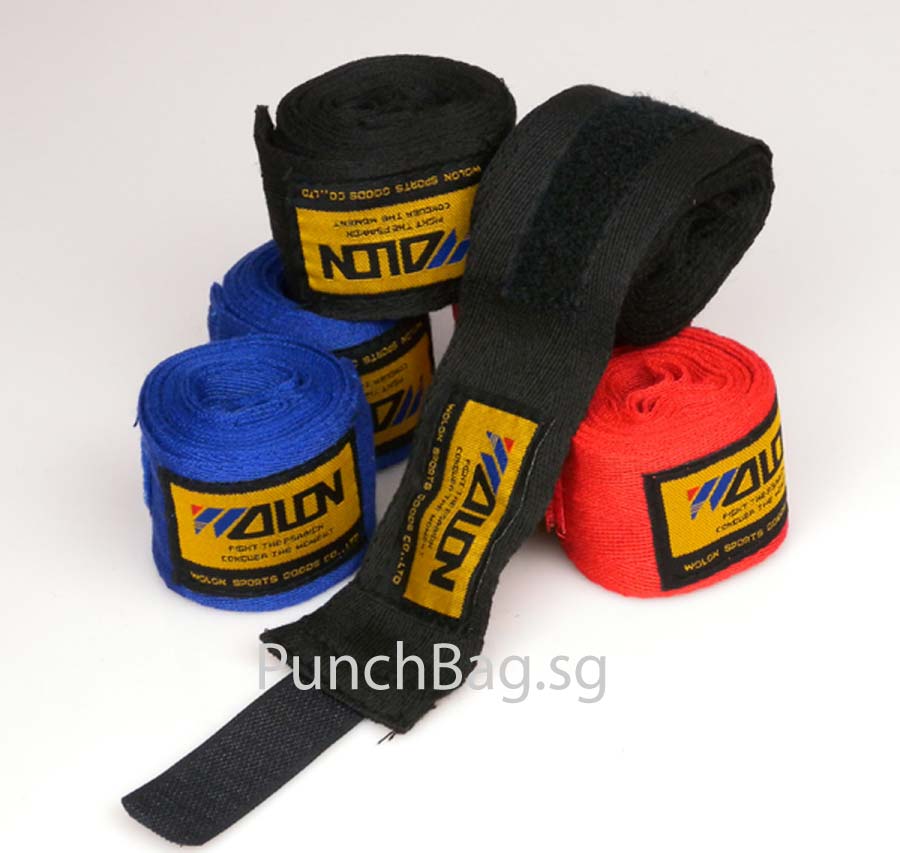
| Free hand wraps included | 2 | 2 |
| Expected lifespan | Very long — few moving parts | Long, but the spring is a wear item |
What a hanging bag does better
It pushes back honestly
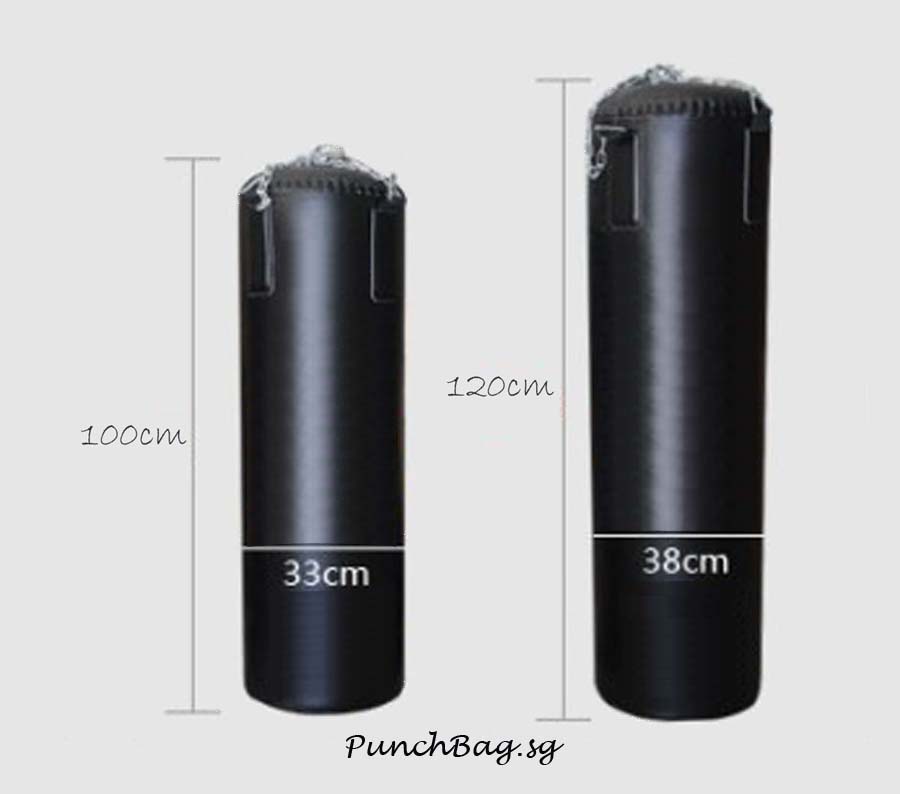
Mass is what resists a punch. A 25kg bag hanging on a chain gives you feedback that no spring mechanism replicates: hit it badly and it barely moves while your wrist absorbs the difference. Hit it correctly and the whole thing travels. That feedback loop is the fastest technique teacher available, and it is why every boxing gym in the world still has a row of hanging bags.
It makes you move
A swinging bag is a moving target. You have to time your entry, get out of the way, and re-establish distance every few seconds. This is the single biggest training advantage hanging bags hold, and it is the one people underestimate most before they own one.
It takes up no floor space
The bag is in the air. In a Singapore flat where floor area is the scarcest resource you have, that matters more than it sounds. A hanging bag lives in a corner and costs you nothing when you are not using it.
If your ceiling or wall can genuinely take a bag, this is the better training tool. The question is almost never which trains you better — it is whether your home can host one.
What a standing bag does better
It has anatomy
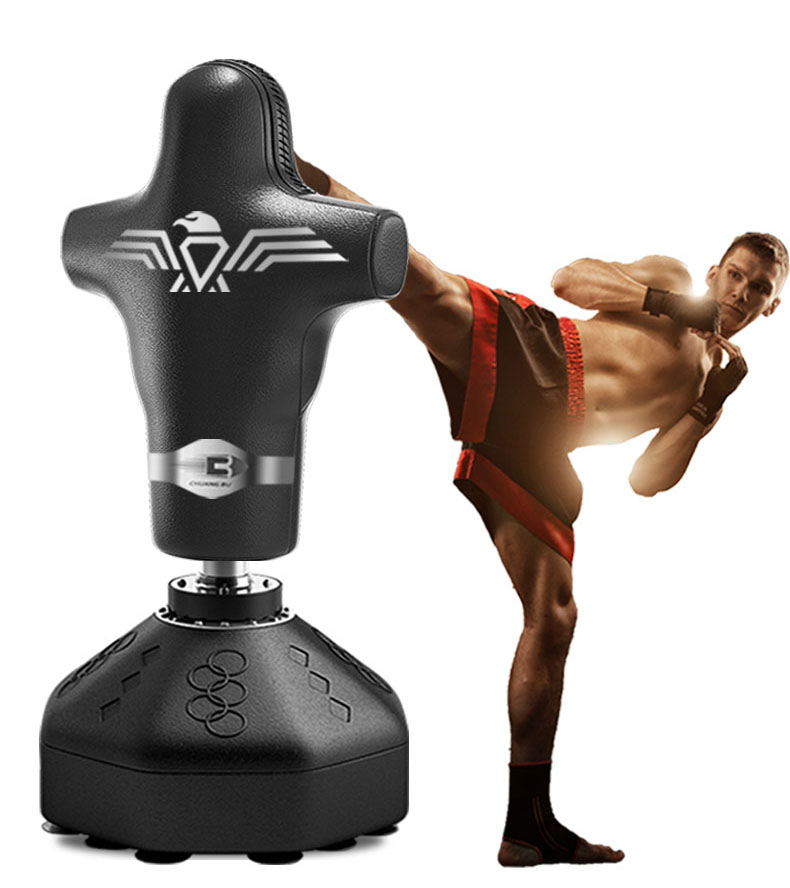
This is the underrated argument. A cylindrical bag teaches you to hit a wall at chest height. A Body Opponent Bag has a jaw, a chin, a solar plexus and a rib line. Trainees who switch from a round bag to BOB usually discover their hooks have been landing about ten centimetres too high for months, because nothing was ever there to tell them otherwise.
It installs in fifteen minutes
Fill the base with water or dry sand, stand it up, done. No drill, no anchors, no structural assessment, no landlord conversation, and nothing to make good when you move out. For a large proportion of buyers this is not a convenience — it is the only reason they own a bag at all.
It rebounds predictably
The spring column absorbs impact and returns the torso to centre. That gives you a consistent rhythm to drill combinations against, rather than waiting for a swinging bag to settle. For repetition work — the same four-punch combination fifty times — it is genuinely more efficient.
It is quieter
A wall-mounted bag pumps energy directly into a structural wall you share with a neighbour. A standing bag puts most of that load into its own base, sitting on your floor, where a rubber mat can absorb it. In an HDB block this difference is not academic — it is the difference between a hobby and a complaint. We covered the detail in training without annoying your neighbours.
The Singapore complication
HDB guidance limits objects suspended directly from a ceiling to roughly 6kg. Our bag is 25kg — more than four times that. This is not a technicality you can work around with a better hook; it is a structural limit on the slab.
This single fact reshapes the whole comparison for most readers. In much of the world, "hanging bag" means a ceiling hook and an afternoon's work. Here it means one of two things:
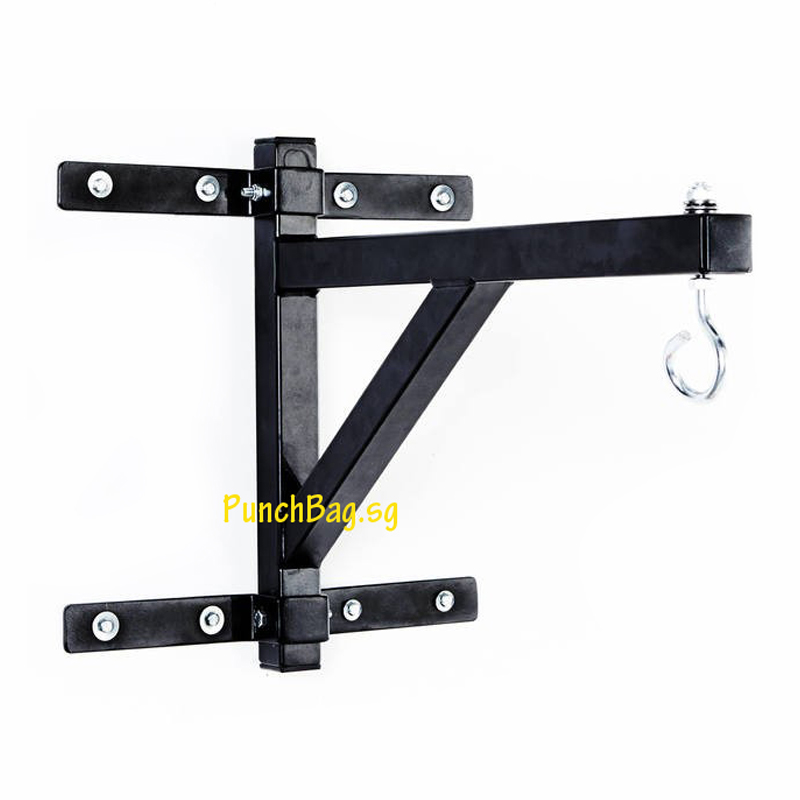
- A wall bracket on a structural concrete wall. This works, it is common, and it is what the WM-40 bracket exists for. But it needs the right wall, the right anchors and a rotary hammer drill.
- A free-standing frame. Effective, but it occupies more floor space than a BOB and costs more than both a bag and a bracket together.
So the practical question in Singapore is rarely "hanging or standing" in the abstract. It is: do I have a structural wall I am allowed to drill into? If yes, hanging wins on training value. If no, standing wins by default — and the targeting advantage means you are not settling for less.
How to choose in 30 seconds
Buy a hanging bag if…
- You own your home, or your landlord has agreed in writing
- You have a solid brick or reinforced concrete wall available
- Power development and conditioning are your priorities
- You want to train footwork and timing, not just punches
- Floor space is tight
Buy a standing bag if…
- You rent, or drilling is not permitted
- You are not confident about what is inside your walls
- Accuracy and target practice matter more to you than raw power
- Noise complaints are a realistic concern
- You may move house and want to take the bag with you easily
Both bags are set up at our Lower Delta Road showroom. Ten minutes on each settles the question faster than any article can, this one included.
Call +65 6372 1581, email hello@punchbag.sg, or come to the showroom and ask in person. We would rather talk you out of the wrong bag than sell you one.