How to Wrap Your Hands for Boxing
To wrap your hands for boxing: anchor the thumb loop, make three to four turns around the wrist, three around the knuckles, then figure-eight passes between each finger, and finish back at the wrist. A correctly wrapped hand tightens into one solid fist when you close it, without cutting off circulation.
Why wraps matter more than gloves
This is the thing beginners have backwards. Padded gloves exist largely to protect what you hit — they spread the force of a punch over a wider, softer surface so the person on the other end takes less damage. What protects your hand is the wrap underneath.
Your hand contains 27 bones held together by soft tissue. Left loose, each one moves independently when you hit something, and the force concentrates wherever the alignment gives way first — usually the base of the index knuckle or the wrist. A wrap binds those bones into a single structure, so impact loads the whole hand at once.
A properly wrapped hand tightens into a solid fist when the hand is closed. That is the whole test, and it takes two seconds to run.
Hitting a heavy bag without wraps is where most home-training hand injuries come from. The bag does not move out of the way, people hit harder than they would at a partner, and there is no coach watching the wrist angle. At $8 each — and two free with every punching bag — wraps are the cheapest insurance in the sport.
What you need
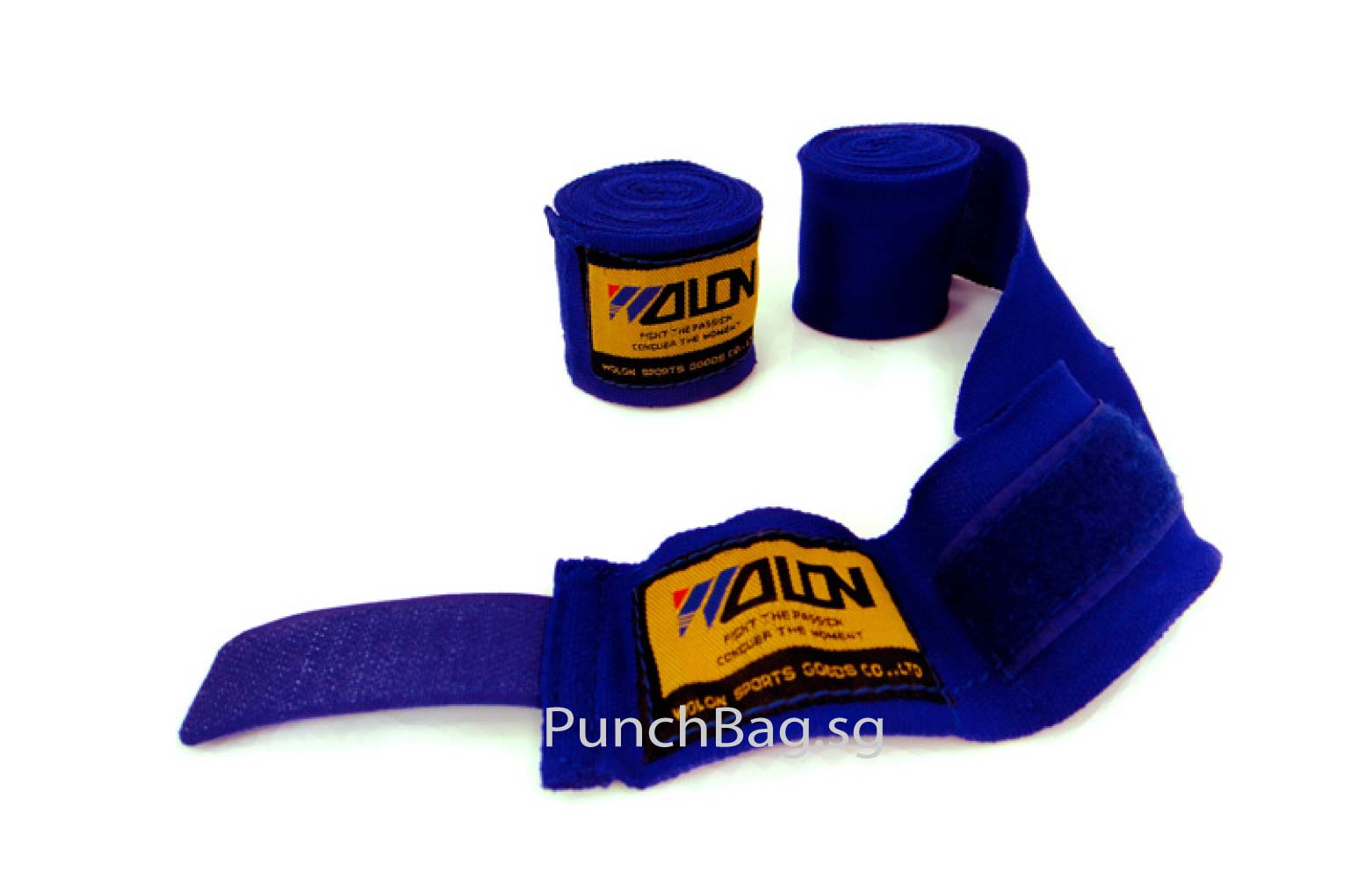
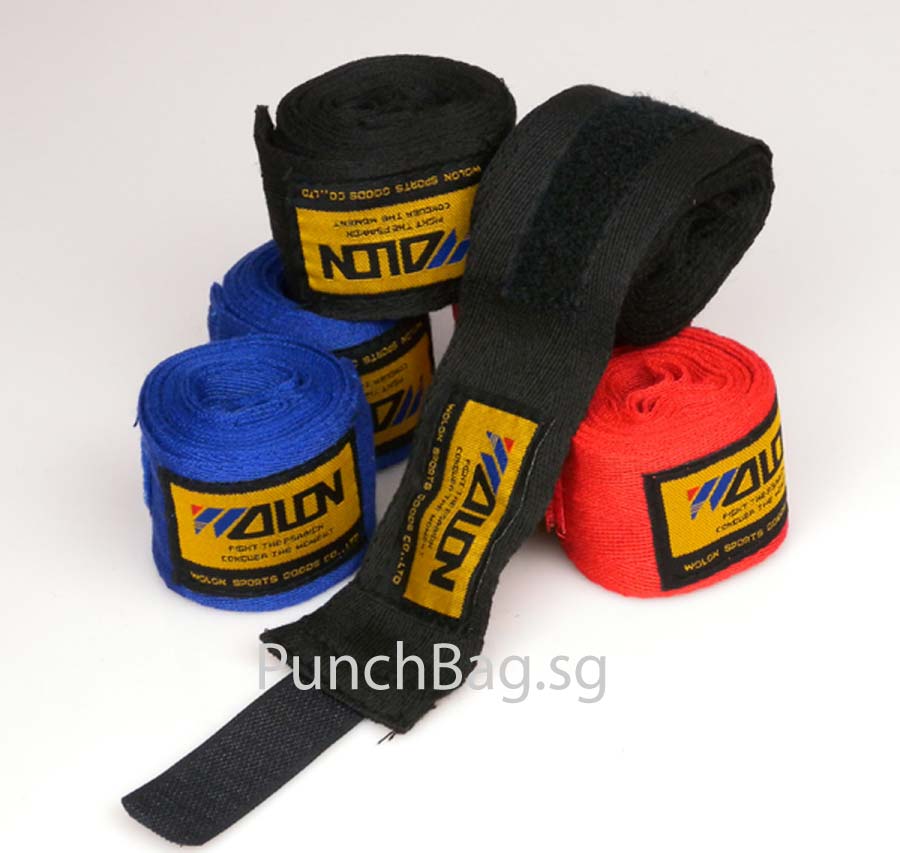
- A 2.4m cotton wrap for each hand. This is the standard adult length. It gives enough material for the wrist turns, knuckle passes and figure-eights without bulking up so much that your glove stops closing.
- Two minutes per hand the first few times. Under a minute once it becomes automatic.
Woven cotton holds its tension through a session, which stretch nylon does not. It also breathes, which matters a great deal in Singapore.
The ten-step wrap
Wrap away from your body: anticlockwise on the right hand, clockwise on the left. This runs with the direction the thumb pulls when you close a fist, so the whole structure tightens rather than unwinding.
- Start with the thumb loop. Slip the loop over your thumb with the wrap running across the back of your hand, not the palm. This sets the direction for everything that follows.
- Anchor the wrist. Make three to four full turns around the wrist. This is the foundation — most bag injuries are bent wrists, not broken knuckles.
- Cross to the knuckles. Bring the wrap diagonally across the back of the hand and make three turns around the knuckles, keeping them flat and even.
- Return to the wrist. Cross back down diagonally and take one turn around the wrist to lock the knuckle wraps in place.
- Figure-eight the little finger. Come up between the little and ring fingers, over the knuckles, and back down to the wrist.
- Figure-eight the remaining gaps. Repeat between ring and middle, then middle and index. Each pass returns to the wrist before the next begins.
- Cover the thumb. Take one turn around the base of the thumb and back to the wrist, binding it to the hand rather than leaving it free.
- Build the knuckle pad. Use any remaining length on further knuckle turns, which builds a cushion over the striking surface.
- Finish at the wrist and fasten. End with the hook-and-loop strap on the inside of the wrist so it does not catch on your glove lining.
- Test the fist. Close your hand. It should tighten into one solid unit. Open it — no tingling, no colour change. Adjust if either fails.
Keep your hand slightly spread while wrapping and your fingers apart. If you wrap with your hand clenched, the wrap will be too tight the moment you relax.
Getting the tension right
Firm, not throttling. There are two tests:
- Closed-fist test. Make a fist. The wrap should draw everything together into one solid unit. If your hand still feels loose inside the wrap, it is too slack — particularly around the wrist.
- Open-hand test. Open your hand and hold it for a minute. No tingling, no throbbing, no colour change in the fingertips. If any of those appear, the knuckle turns are too tight — that is where people over-tighten most.
Tension should be highest at the wrist, moderate over the knuckles, and lightest between the fingers. Beginners tend to do the opposite, which produces a hand that is simultaneously unsupported and uncomfortable.
Three mistakes that cause injuries
1. Skipping the wrist turns
People are drawn to wrapping the knuckles because that is where the impact visibly lands. But the wrist is where the injuries actually happen — a fist that lands correctly with a bent wrist still transfers force through a joint that cannot take it. Three to four wrist turns first, every time.
2. Leaving the thumb loose
An unbound thumb catches on the bag and levers backwards. Thumb sprains are common, slow to heal, and almost entirely preventable by the single turn in step seven.
3. Wrapping only for sparring
"It is just a light bag session" is how most people injure themselves. Bag work is precisely when the wrap earns its keep. If you are going to hit something, wrap up — see our beginner heavy bag workout for how to structure the session once you have.
Washing and care
Wraps absorb everything your hands produce, and in Singapore humidity they get unpleasant quickly. Wash them every few sessions:
- Roll them loosely rather than balling them up
- Use a mesh laundry bag so they do not tangle around the rest of the wash
- Normal cycle, mild detergent, no fabric softener — it degrades the weave
- Air dry; a tumble dryer will shrink and stiffen them
Buying a spare set so you can rotate is the simplest solution, and at $8 a wrap it is not a difficult decision. Hang the used wraps to dry the moment you finish rather than leaving them balled in a gym bag.
Reading it and doing it are different things. Drop by the showroom and we will wrap one hand while you copy on the other. It takes five minutes and it sticks.
Call +65 6372 1581, email hello@punchbag.sg, or come to the showroom and ask in person. We would rather talk you out of the wrong bag than sell you one.